Ihraam & Talbiyah
Ihraam is the state of purity and holiness. It is basically an intention to perform either Hajj or Umrah or
both. Intention is an important element for Ihraam.
Meeqat
You should attain the state of Ihraam on or before Meeqat. There are five zones mentioned as Meeqat in
different Ahadiths.
An-Nasai: 2653 & 2654
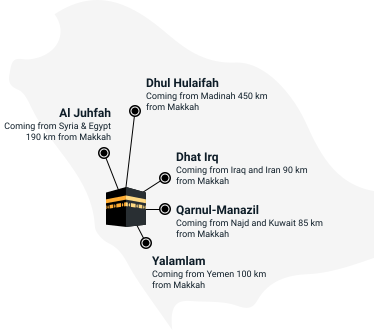
Passing the Meeqat without donning the Ihraam will result in the person being liable for compensatory
sacrifice of a sheep/goat called ‘Dam’.
Things to do before Ihraam
Removing unwanted hair from underneath the armpit and below the navel.
Trim your mustache and shape your beard.
Purify yourself either by taking a bath or performing ablution
(wudu).
Sahih Muslim: 257(a) & Abu Dawud: 1746
Ihraam for Men
Ihraam for men consists of two pieces of unsewn/unstitched clothes.
One of the pieces ‘Izaar’ is used to
cover the lower body (from the navel to the knees). Other piece of
cloth ‘Rida’ is used to cover the upper
body.
In order to wear Ihraam for your lower body, stand with your feet apart to create the right shape,
and hold the first sheet behind you with both top corners of the sheet are in your each hand.

Wrap the cloth around your waist above your navel (from right to left).

Do the same wrap from left to right. Make sure that the entire navel area is covered and your feets
are visible. Cloth should not lose or there should not be any open gap at any point while wrapping
the cloth around the waist.

After wrapping the cloth around your lower body, fold over or roll the top of the cloth several
times along your waistline to keep it in place. Make sure that it ends up higher than your
navel/belly button. If you are using a belt, buckle it about 2 inches below the top of the cloth to
avoid it slipping off. If you are using clips, make sure at least one clip is over the outside end
of the cloth.

You have successfully wear the cloth (Izar) on your lower body.

Now to cover your upper body, hold the other cloth (Rida) horizontally behind your back, with one
top corner in each hand. You should place it around your shoulders like a cape.

Make one side longer than the other and wrap the longer length over your shoulder.

Now wrap the other corner of the sheet over the other shoulder. You have successfully wear the
cloth (Rida) on your upper body.

After wearing Ihraam, offer two ‘Rakat‘ Nafil prayer as long as it is not
undesirable time (Makruh) for
prayer. This Nafil Prayer is Mustahab (preferable). If there is no time to
perform this prayer, one can
still come into the state of Ihraam by making the intention and reciting
Talbiyah.
Abu Dawud: 1770
Talbiyah
After intention and wearing Ihraam clothes, recite 'Talbiyah' loudly:
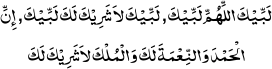
(Labbayk, Allahumma Labbayk. Labbayka La shareeka
laka Labbayk. Innal-hamda wan-n'imata laka wal-mulk, La
shareeka lak.)
Ever at Your service, O Allah, every at Your service. Ever at Your
Service, You have no partner, ever at
Your service. Verily all praise, blessings and dominions are Yours. You
have no partner.”
Sahih Muslim: 1218 (a)
Reciting Talbiyah once is obligatory for entering the state of ‘Ihraam’. Say
it three times is Masnoon
(preferable). However, recite it continuously till reaching Masjid Al-Haram
(before starting Tawaf) is
preferable.
Now you have attained the state of Ihraam, you may now proceed to Masjid
Al-Haram to complete the rest of
Umrah rituals.
Ihraam for Women
There are no specific garments for a woman as Ihraam. Women are expected
to wear clothing as Ihraam that
conceal the shape and covers the body completely, leaving only their
face and hands exposed

Rest of the condition for Ihraam remain the same as mentioned above.
(Offering Two Rakat Nafil for Ihraam and
Reciting Talbiyah).
Prohibitions during the Ihraam
Once you have entered the state of Ihraam and after making the intention, the
following actions are not
allowed:
Wearing stitched/sewn clothes/garments for men. Women can wear their
ordinary clothes.
Covering the head for men and covering the face for women.
Shaving or cutting the hair, or cutting the nails (both men and women).
Wearing perfume or any other thing that have fragrance (both men and
women).
Cover the middle-bone of the upper part of the feet (both men and
women).
Hunting / Killing animals, even ant or lice (both men and women).
Sexual activity (both men and women).
Surah Al-Baqarah 2:196-197, Surah Al-Maidah
5:95, An-Nasai: 2856, Sahih Bukhari: 5805


